
https://jknylaw.com/personal-injury-resources/intentional-tort/
TWO OFFICES IN NEW YORK CITY Hablamos Español

call for a free consultation (212) 262-0289

Intentional Tort
NYC Personal Injury Lawyer » New York Personal Injury Resources » Intentional Tort

Intentional Tort
An intentional tort is a deliberate act of misconduct that harms someone, either physically, emotionally, or financially.
Although a tort is not the same as a crime, many intentional torts are also crimes.
The victim of an intentional tort can file a claim against the perpetrator seeking monetary damages.
Table of Contents
Examples of Intentional Torts
Following are some examples of common intentional torts:
- Assault: Putting someone in apprehensive of immediate physical harm. Pointing a gun in someone’s face is an example, even if you never pull the trigger.
- Battery: Making offensive or harmful physical contact with someone without their consent. No injury is required; sexual assault constitutes battery, for example.
- Wrongful death: Intentionally and unjustifiably killing someone.
- False imprisonment: Deliberately confining someone without the legal authority to do so. Either a police officer or a civilian can commit this offense.
- Conversion: Conversion is the taking of personal property (not real property) with the intent to permanently deprive the owner of it.
- Trespass to land: Intentional entry onto your land or into your dwelling without your permission constitutes trespass to land.
- Intentional infliction of emotional distress: Imagine a cruel prankster who calls a father, identifies themselves as the coroner, falsely tells the father that his daughter has been killed in a car accident, and asks him to come to the morgue to identify the body. This is but one example.
The foregoing is not an exhaustive list of all possible intentional torts.
Damages
“Damages” means compensation for your losses. New York recongizes three kinds of damages: economic damages, non-economic damages, and punitive damages.
Economic Damages
Economic damages are easy to count damages such as medical expenses, lost earnings, and out-of-pocket expenses arising directly from the tort.
Non-Economic Damages
Non-economic damages are intangible damages such as pain and suffering, emotional distress, humuliation, and similar losses. Courts place concrete dollar values on these losses every day.
Punitive Damages
Courts award punitive damages when the defendant’s behavior was so outrageous that the court wants to punish the defendant, not only to compensate you. The court will add punitive damages to your economic and non-economic damages.
Courts are normally reluctant to award punitive damages. They are more willing to do so, however, when the defendant acts intentionally.
What’s the Difference Between an Intentional Tort and a Crime?
Many intentional torts are also crimes. Punching someone in the face (without justification) is both an intentional tort and a crime. So is pointing a gun in someone’s face, even if you don’t pull the trigger.
The main differences between an intentional tort and a crime are the venue, who initiates the claim, and the standard of proof.
- In terms of venue, an intentional tort is tried in civil court, and a crime is tried in criminal court.
- In an intentional tort, it is the victim who pursues the claim. In a crime, it is the prosecutor who initiates the claim.
- The defendant in an intentional tort must be found liable by a preponderance of the evidence. The defendant in a criminal prosecution must be found guilty beyond a reasonable doubt.
Inconsistent results are not uncommon. A defendant might be found not guilty of murder, for example, but still lose a wrongful death lawsuit over the death of the same person. Criminal prosecutions and civil lawsuits are two completely separate proceedings.
The Standard of Proof
Closely examine the following three standards of proof that courts apply, depending on what is at stake.
“Beyond a reasonable doubt”
“Beyond a reasonable doubt” doesn’t mean “beyond a shadow of a doubt.” It does mean enough evidence that no reasonable person would seriously doubt the defendant’s guilt. This standard is used exclusively in criminal cases.
“A preponderance of the evidence”
A preponderance of the evidence is enough evidence to convince the ourt that your version of events is at least slightly more than 50% likely to be true. In other words, your evidence outweighs the defendant’s evidence, no matter how slightly. A preponderance of the evidence is the standard you need to win a personal injury lawsuit.
“Clear and convincing evidence”
“Clear and convincing evidence” is a standard of proof that demands more than “a preponderance of the evidence”, but less than “beyond a reasonable doubt.” In personal injury law, it is normally used only when a plaintiff asserts a claim for punitive damages. Criminal trials do not use this standard.
The Insurance Problem
Insurance pays a significant portion of negligence claims. Unfortunately, very few insurance policies will pay out over an intentional tort. What you can do in many instances, however, is sue an institution responsible for supervising the perpetrator for the tort of negligent supervision. There are also other workarounds that can result in generous settlements.
Hire a New York City Personal Injury Attorney
Proving an intentional tort can be difficult, especially if you are seeking punitive damages. It can also be difficult to identify a defendant who can afford to pay. Nevertheless, a skilled New York City personal injury lawyer at Law Offices of Jay S. Knispel Personal Injury Lawyers might very well find a way for you to walk away with a tidy sum in your pocket, even after paying legal fees, contact us today at (212) 262 0289.
Resources
NYC Practice Areas
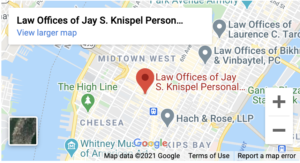
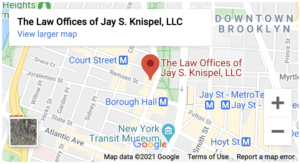
New York City Office
450 7th Ave Suite 1605
New York, NY 10123
(212) 262 0289
Brooklyn Office
26 Court St., Suite 2511
Brooklyn, NY 11242
(718) 802-1600
We are available to take your call 24/7
get started today
If you or a loved one was injured by a negligent person or suffered a work injury, we would like to hear from you. Please fill out the form below!
New York Injury Attorneys
450 Seventh Ave., Suite 1605 New York, New York 10123 New York CIty Personal Injury Law Office Map Get Directions
Brooklyn Injury Attorneys
26 Court St., Suite 2511 Brooklyn, New York 11242 Brooklyn Personal Injury Law Office Map Get Directions

Areas We Serve
At Law Offices of Jay s. Knispel Personal Injury Lawyers, our injury attorneys serve the following areas:
Upper Manhattan, Manhattan, Harlem, Upper East Side, Upper West Side, Lincoln Square, Diamond District, Midtown, Murray Hill, Times Square, Hudson Yards, Hell’s Kitchen, Garment District, Koreatown, Rose Hill, Chelsea, Union Square, East Village, Greenwich Village, Lower East Side, SoHo, Little Italy, Chinatown, Financial District, Tribeca, Lower Manhattan, Brooklyn, Queens, Bronx, and Staten Island.
About Our Firm
Law Offices of Jay s. Knispel is a personal injury law firm fighting for accident victims across the state of New York. Our personal injury attorneys have recovered millions of dollars on verdicts and settlements. If you have been injured in NYC, contact our law firm for a free consultation.
Practice Areas
Our experienced team handles slip and fall accidents, premises liability cases, motor vehicle crashes, workplace injuries, construction accidents, workers’ compensation or wrongful death lawsuits.
Copyright © 2025 LAW OFFICES OF JAY S. KNISPEL PERSONAL INJURY LAWYERS Disclaimer Sitemap Privacy Policy NYC Personal Injury Lawyers SEO by iLawyerMarketing
MANHATTAN PERSONAL INJURY LAWYER
 R.M.P Marotta Long Island
Leave a comment