
https://www.thedrive.com/news/volvo-ex90s-lidar-sensor-will-fry-your-phones-camera
Volvo EX90’s Lidar Sensor Will Fry Your Phone’s Camera
Laser beams don’t play nice with camera image sensors, and Volvo recommends avoiding close-up photography or using a protective filter if you must snap a pic.
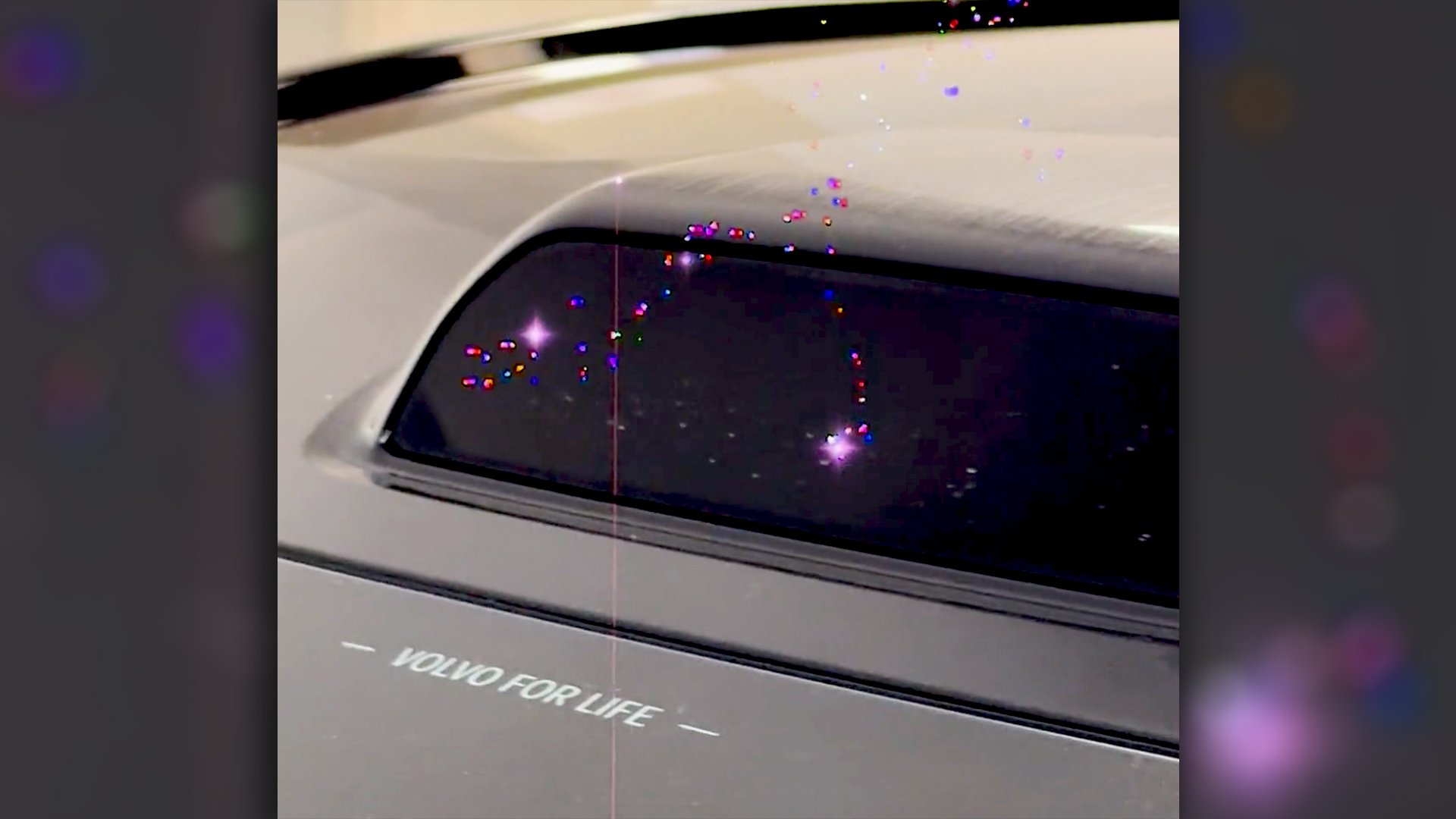
Try to record a car’s lidar sensor, and you’ll see a trail of multicolored specks in its wake. Those are freshly fried pixels on the camera’s image sensor. Screenshot via Reddit, The Drive
Get The Drive’s daily newsletter
Email address
Terms of Service & Privacy Policy.
Cameras are weird, and some situations in everyday life expose this weirdness. Ever try to film or snap a picture of an old tube TV? You get bands of colors, rather than a complete image. Or, have you ever taken a video of a plane’s propeller in motion? Depending on how well your camera’s framerate matches the speed of the aircraft’s blades, they might appear perfectly still as the plane takes flight. How cool is that? The downside to this weirdness is that, in much the same way it’s unsafe to stare at the sun, there are some sights you shouldn’t point a camera at—like a Volvo EX90’s lidar sensor.
That pod on the roof of Volvo’s new electric SUV is essentially just shooting out a bunch of high-powered infrared beams, determining the distance of the vehicle’s surroundings by measuring the time taken for reflected light to return to the sensor. If you point your phone’s camera directly at those beams, you’ll observe some strange phenomena, like what’s happening in the image above. What you’re seeing is a laser frying pixels on one of the device’s image sensors.
Credit to Reddit user Jeguetelli, who broke their smartphone for science, so the rest of us know what not to do. The constellation of artifacts disappears because the person filming zooms out, prompting the phone to switch to a shorter lens backed by a separate, healthy image sensor. To assuage the fears of some concerned redditors, this is presumably why lidar doesn’t pose the same threat to backup cameras on other vehicles, which also typically use ultra-wide-angle lenses. https://embed.reddit.com/r/Volvo/comments/1ke98nv/never_film_the_new_ex90_because_you_will_break/?embed=true&ref_source=embed&ref=share&utm_medium=widgets&utm_source=embedv2&utm_term=23&utm_name=post_embed&embed_host_url=https%3A%2F%2Fwww.thedrive.com%2Fnews%2Fvolvo-ex90s-lidar-sensor-will-fry-your-phones-camera


null
It should be said that the risk here is inherent to lidar technology, and has nothing to do with Volvo’s specific implementation on the EX90. In fact, earlier this year, the automaker even issued a warning against directing external cameras at the vehicle’s lidar pod for the very reasons discussed. “Do not point a camera directly at the lidar,” one support page admonishes in no uncertain terms. Unfortunately, while that sort of information might be clear to owners (the ones who crack open their vehicles’ manuals, anyway), this is something the entire public ought to be aware of, especially as semi-autonomous cars with lidar systems become more common on our streets.
The Drive reached out to Volvo for a little more insight into the issue, as well as any other recommendations. “It’s generally advised to avoid pointing a camera directly at a lidar sensor,” a representative responded over email. “The laser light emitted by the lidar can potentially damage the camera’s sensor or affect its performance.”
The company specifically called out “close-ups” as the problem, meaning that our phones should be safe with distant shots, and also offered a tip for those of us who may need to capture such images. (Thank you!) “Using filters or protective covers on the camera lens can help reduce the impact of lidar exposure,” Volvo said. “Some cameras are designed with built-in protections against high-intensity light sources.”Volvo
The sensor Volvo uses in the EX90 is understood to be eye-safe, even if it’s not necessarily camera-safe. We’re no experts on laser imaging, so we’ll defer to Lidar News, which published back in January that “[t]he human eye is mostly sensitive to light in the visible spectrum (roughly 400-700nm) and less sensitive to [near-infrared] light. Because 1550nm is at a safer wavelength for the human eye, [the EX90’s laser] can operate at higher power.” Higher power translates to longer range, which is obviously critical for vehicles built to achieve any level of self-driving.
All that said, if you haven’t yet had the opportunity to test your phone’s warranty in the presence of an EX90, you’re not alone. The electric SUV only began reaching U.S. dealers early this year, and starts at $81,290.
Got a tip? Send it in: tips@thedrive.com

Adam Ismail
News Editor
Adam Ismail is the News Editor at The Drive, coordinating the site’s slate of daily stories as well as reporting his own and contributing the occasional car or racing game review. He lives in the suburbs outside Philly, where there’s ample road for his hot hatch to stretch its legs, and ample space in his condo for his dusty retro game consoles.
115
Sort by
Trending
Why There’s a 1957 Cadillac Encased in Concrete In a Chicago Parking Garage
Getting Nailed by Exploding Turbo Shrapnel Is a Good Reminder to Put Safety First
More in Self-Driving Tech
Texas Man Is Tired of His New Ford F-150 Randomly Braking on the Highway
Tesla Autopilot Fails Wile E. Coyote Test, Drives Itself Into Picture of a Road
When Self-Driving Actually Works: Inside Honda’s Fleet of Autonomous Factory Robots
Sony Honda’s Afeela EV Project Is Under Pressure. That’s Good
More in Car Tech
Slate’s Electric Pickup Marks the Return of the Compact Single Cab Truck
A Mysterious Force Is Knocking Out Apple CarPlay in Boston
Clever Toyota GR86, Subaru BRZ Bolt-Ons Turn Control Arms Into Brake Coolers
The New VW Golf R Doesn’t Have the GTI’s Steering Wheel Buttons for One Annoying Reason
More in News
Street-Legal Porsche 962C For Sale Is How You One-Up Everyone at Cars and Coffee
2,031-HP Hennessey Venom F5 Evolution Claims 0 to 200 MPH in 10 Seconds
The 2,000-HP Lotus Evija Is the Quickest Lotus Ever, Yet Nobody Wants It
BMW Recorded Plants and Employees for the Neue Klasse’s Sound

NEWSLETTER SIGNUP
Get the latest car news, reviews, and features.
By signing up you agree to our Terms of Service and Privacy Policy.
FOLLOW US
DISCLAIMER(S)
Some benefits of our Car Shopping program may not be available in your area. Please see terms for details.
 R.M.P Marotta Long Island
Leave a comment