
https://psychiatryonline.org/doi/10.1176/pn.36.12.0008
Reference #1
Full access
Professional News
Publication Date: 15 June 2001
Stalking Victims Endure Severe Psychological Stress
Christine LehmannAuthors Info & Affiliations
Publication: Psychiatric News
https://doi.org/10.1176/pn.36.12.0008
When actress Rebecca Schaeffer, who starred in the television show “My Sister Sam,” was brutally murdered by fan John Bardo in 1989, she had been stalked by him for two years.
Her murder led California to enact the first antistalking law in the nation in 1990. By 1993 all 50 states and the District of Columbia had enacted some form of antistalking law.
It appears, however, that stalking persists and may even be increasing.
Eight percent of women and 2 percent of men in the U.S. will be stalked in their lifetime, according to a 1998 study by the Department of Justice.
Similar prevalence rates have been reported in Australia. Women aged 18 to 35 are most likely to be stalked (11 percent report being stalking victims), followed by women aged 36 to 55 (8 percent), and women 56 or older (4 percent), said Australian stalking expert Paul Mullen, M.D., at APA’s 2001 annual meeting in New Orleans last month.
By contrast, 8 percent of men between the ages of 18 and 35 were stalked, as were 4 percent of men aged 36 to 55, and 3 percent aged 56 and older, according to Mullen, who is a professor of forensic psychiatry at Monash University in Victoria, Australia. He is also clinical director of Victorian Institute of Forensic Mental Health.
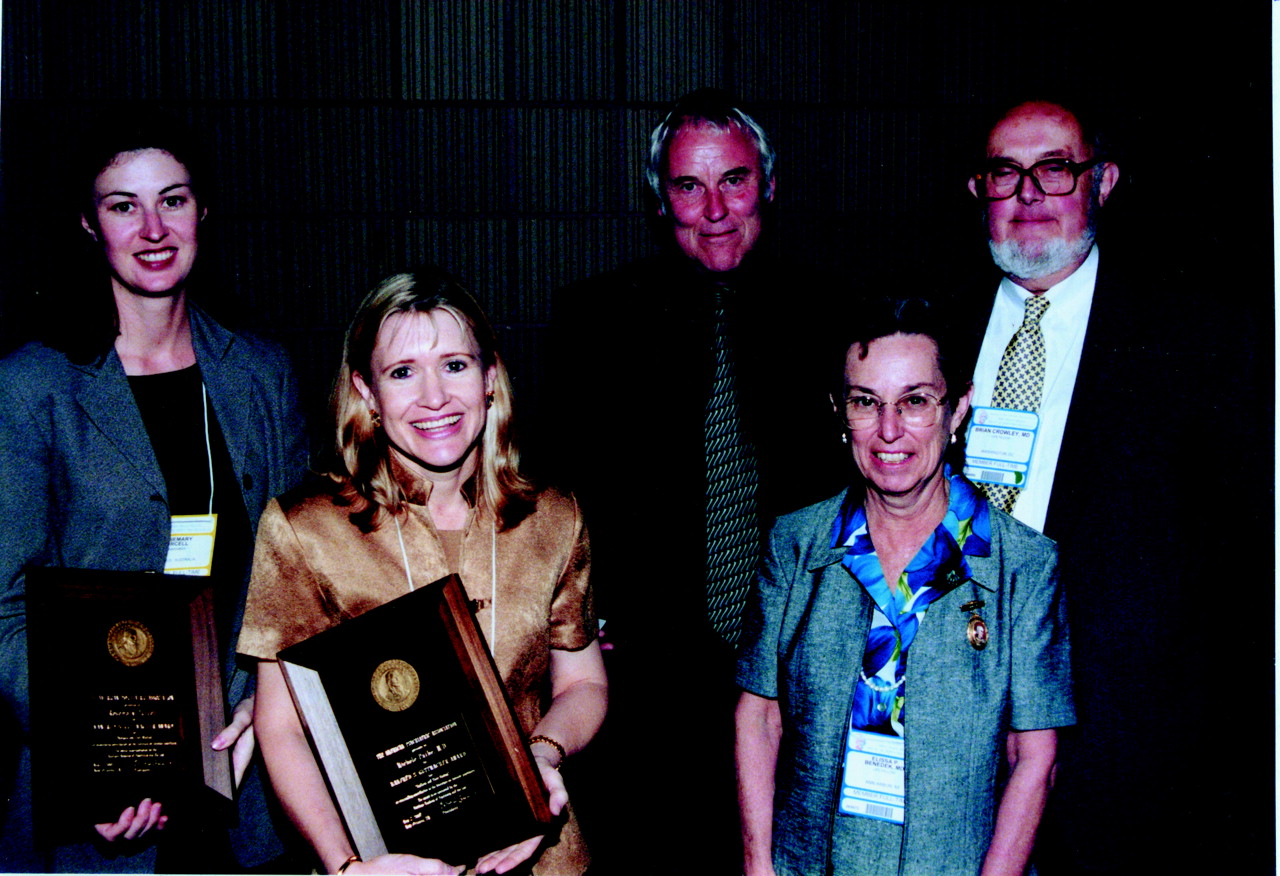
The 2001 Manfred S. Guttmacher awardees are (from far left) Rosemary Purcell, Michele Pathé, M.D., and Paul Mullen, M.D. The award was presented by Elissa Benedek, M.D. (second from right), and Brian Crowley, M.D.
Mullen and colleagues Michele Pathé, M.D., and Rosemary Purcell received the Manfred S. Guttmacher Award last month, which honors an outstanding literary contribution to the field of forensic psychiatry. The award is jointly presented by APA and the American Academy of Psychiatry and the Law.
Their book Stalkers and Their Victims was published last year by Cambridge University Press. The award is given by APA and the American Academy of Psychiatry and the Law.
What Is Stalking?
Mullen defined stalking as a set of “behaviors that last more than two weeks and involve repeated and persistent attempts to impose on another person unwanted contacts and/or communications which induce fear or distress.” He distinguished stalking, which has been known to last for up to 40 years, from episodes of harassment, which end within two weeks.
Stalkers may communicate with their victims by telephone, e-mail, fax, letters, and notes attached to the victim’s property. They attempt to be physically close to the victim by approaching, following, surveilling, and loitering near that person, said Mullen.
Another troublesome behavior is sending unsolicited gifts to the victim. “Gifts can range from the banal to the sinister, such as sending dead animals or coffins in the mail,” he explained.
Stalkers will sometimes turn the tables on their victims and file a complaint in court against them. “When the victim files a complaint, the court is confused about who’s stalking whom,” said Mullen.
Threats made by stalkers should not be taken lightly. Mullen referred to a study he and Pathé reported in the January 1997 British Journal of Psychiatry (BJP) that showed 58 percent of the 100 victims studied were physically threatened by their stalkers, and 43 percent of that group were physically or sexually assaulted. Stalkers with a history of criminal convictions or substance abuse were more likely to threaten their victims, Mullen stressed.
Women are more likely to be stalked than men. In the BJP study, women accounted for 83 percent of the victims, according to Mullen.
About 30 percent of the stalkers were former spouses or partners of the victim. Another 35 percent were coworkers or disgruntled clients or patients. The remainder were casual acquaintances or strangers.
Professionals at Risk
“Professionals who work with the lonely and unstable are at risk of being stalked,” said Mullen. Based on conversations with psychiatrists in Australia and the U.S., Mullen estimated that about 15 percent have been stalked by a patient during their career. Not surprisingly, a high percentage of stalkers have personality disorders, he said. (See article on page 8.)
Victims are often forced to alter their lives to avoid the stalker. Mullen’s study found that 53 percent of his subjects quit or changed jobs, 40 percent moved to a different home, and 70 percent curtailed social activities.
In addition to the physical dangers, stalking takes a severe psychological toll on its victims. Eighty-three percent of Mullen’s study subjects were diagnosed with an anxiety disorder, and 37 percent with posttraumatic stress disorder (PTSD). An additional 18 percent had PTSD symptoms but did not meet formal diagnostic criteria. Twenty-four percent had suicidal ideation, and 25 percent increased their alcohol consumption and/or cigarette smoking, which, stated Mullen, were attributable to having been stalked.
Treatment Suggestions
Mullen has found that cognitive-behavioral therapy works well in managing the anxiety stalking victims experience. He also uses medications such as SSRIs for some patients.
“It is important to inform and educate family members about the stalking and enlist their help in managing it,” he stated.
He also stressed that victims of stalking, like victims of sexual or physical abuse, often blame themselves for the situation. Because they feel shame or misplaced guilt, they do not share their ordeal with others and become more isolated and afraid, said Mullen.
He emphasized the importance of counseling the victim to realize that he or she is not responsible for the stalking.
Mullen advises victims to file a complaint with the police if the stalking episodes continue for more than two weeks. “To prove that the perpetrator is guilty of a crime and have the court order treatment, evidence is critical. Do not destroy answering-machine tapes, notes, letters, e-mails, or gifts in a moment of distress,” he advised. ▪
Advertisement
null
Related Articles:Don’t Underestimate Dangerousness Of Female Stalkers, Study UrgesJoan Arehart-Treichel, Psychiatric News, 2002Stalker Classification Aids Diagnosis, TreatmentChristine Lehmann, Psychiatric News, 2001Surviving StalkingR. Andrew Schultz-Ross, American Journal of Psychotherapy, 2018Female survivors’ experiences of authorities’ actions in cases of partner stalking
Nelli Puronvarsi, Journal of Gender-Based Violence, 2020Coercive control and technology-facilitated parental stalking in children’s and young people’s lives
Anna Nikupeteri, Journal of Gender-Based Violence, 2021A campus LGBTQ community’s sexual violence and stalking experiences: the contribution of pro-abuse peer support
Advertisement
null

AboutContent ArchiveSubmit a Letter to the Editor or ArticleIssue Alert Sign UpSubscribe to Print Version









Follow us
© 2025 American Psychiatric Association
null
 R.M.P Marotta Long Island
Leave a comment